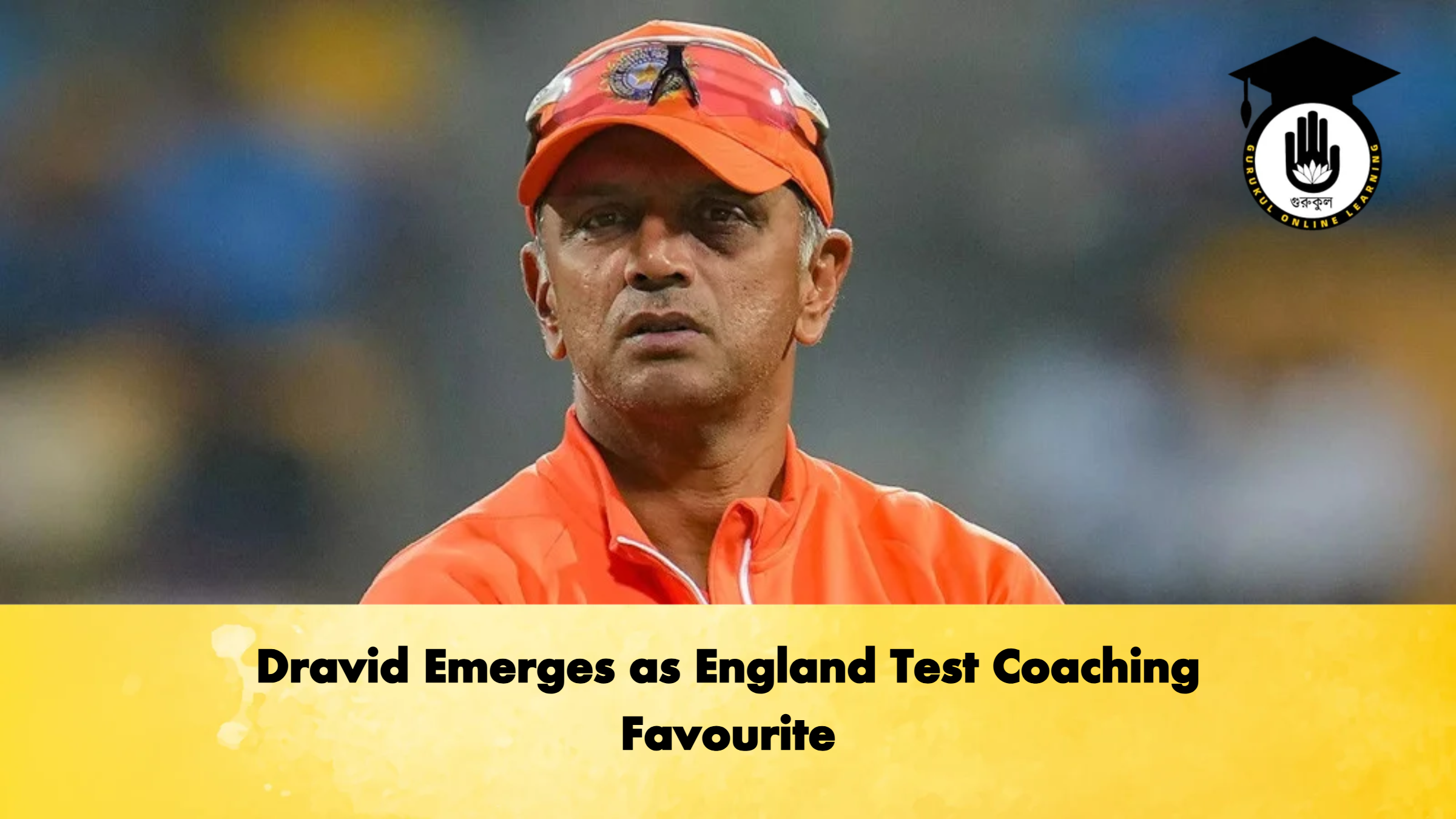
The England and Wales Cricket Board (ECB) has stepped up its search for a new head coach for the England men’s Test side following the end of Brendon McCullum’s tenure in the role. Among the leading candidates under consideration is former India captain Rahul Dravid, whose reputation as one of the game’s finest tacticians and most respected coaches has made him a prominent contender for one of cricket’s most demanding positions.
The coaching vacancy arose after England’s disappointing 2-1 home Test series defeat to New Zealand, a result that prompted the ECB to make a significant change to the leadership of its red-ball team. While McCullum has relinquished responsibility for the Test side, the board continues to place considerable faith in his coaching abilities. He will remain in charge of England’s white-ball teams, overseeing both the One-Day International and Twenty20 International squads.
The decision reflects the ECB’s growing belief that England’s Test and limited-overs teams require distinct coaching philosophies and long-term strategies. By separating the roles, the board hopes to provide each format with a dedicated focus while addressing the specific challenges facing the Test side.
Reports suggest that the ECB has already begun the formal recruitment process and has drawn up a shortlist featuring several internationally recognised coaches with proven records at the highest level. Among them, Dravid has generated the greatest interest.
Widely known as ‘The Wall’ for his remarkable batting career, Dravid has also established himself as one of the most accomplished coaches in modern cricket. His tenure as India’s head coach culminated in the country’s triumph at the 2024 ICC Men’s T20 World Cup, while under his guidance India also reached the final of the 2023 ICC World Test Championship. Those achievements reinforced his reputation for building disciplined, technically sound teams capable of competing consistently across formats.
Long before taking charge of the senior national side, Dravid had earned widespread praise for his work with India’s Under-19 and India A teams. He played a pivotal role in nurturing several young cricketers who later became regulars in international cricket. His emphasis on technical excellence, patience and player development has long been regarded as one of the strongest aspects of his coaching philosophy.
Despite his impressive credentials, Dravid’s personal priorities may influence any potential appointment. After concluding his spell with the Indian national team, he indicated that he did not wish to return immediately to a demanding full-time coaching role that required year-round commitments. Instead, he expressed a desire to spend more time with his family and place greater emphasis on his personal life after years of extensive international travel.
The ECB is understood to be aware of those preferences. Reports indicate that the board is exploring whether the structure of England’s Test coaching role could offer greater flexibility, allowing Dravid to spend significant periods in India when the international calendar permits. Compared with white-ball cricket, the Test programme is often more concentrated into specific windows, potentially making such an arrangement more practical.
If Dravid ultimately accepts the role, it would represent a landmark moment in English cricket. He would become the first Indian to serve as head coach of the England men’s national team, highlighting the increasingly global nature of elite coaching appointments. Such a move would also underline how international cricket has evolved, with expertise, leadership and proven success carrying greater weight than nationality.
Dravid, however, is far from the only candidate under consideration. The shortlist reportedly includes former England coach Andy Flower, whose previous spell in charge delivered one of the team’s most successful periods in modern history. Former England spinner Richard Dawson has also been linked with the position, alongside ex-England all-rounder Andrew Flintoff, whose coaching credentials have continued to grow in recent years.
Other experienced international figures believed to be in contention include Sri Lankan great Kumar Sangakkara, New Zealand’s highly regarded former coach Mike Hesson, and former Australia head coach Justin Langer. Each brings extensive experience in elite cricket, giving the ECB a strong pool of candidates with differing coaching styles and leadership philosophies.
England’s recent performances in Test cricket have exposed several areas requiring improvement. Questions have been raised over the batting line-up’s consistency, the effectiveness of bowling strategies during crucial phases of matches, and the team’s ability to maintain control in pressure situations. Addressing those shortcomings will be one of the primary responsibilities of the new head coach.
Beyond tactical improvements, the successful candidate will be expected to strengthen England’s long-term planning, enhance the team’s mental resilience and oversee the development of the next generation of Test cricketers. With major international assignments on the horizon, the appointment is likely to play a significant role in shaping England’s fortunes in the traditional format for years to come.
The cricketing world is now waiting for the ECB’s final decision. Whether Rahul Dravid chooses to embrace what would be one of the most intriguing coaching opportunities in international cricket, or whether another distinguished candidate is selected, the appointment is expected to attract widespread attention and could mark the beginning of a new era for England’s Test team.