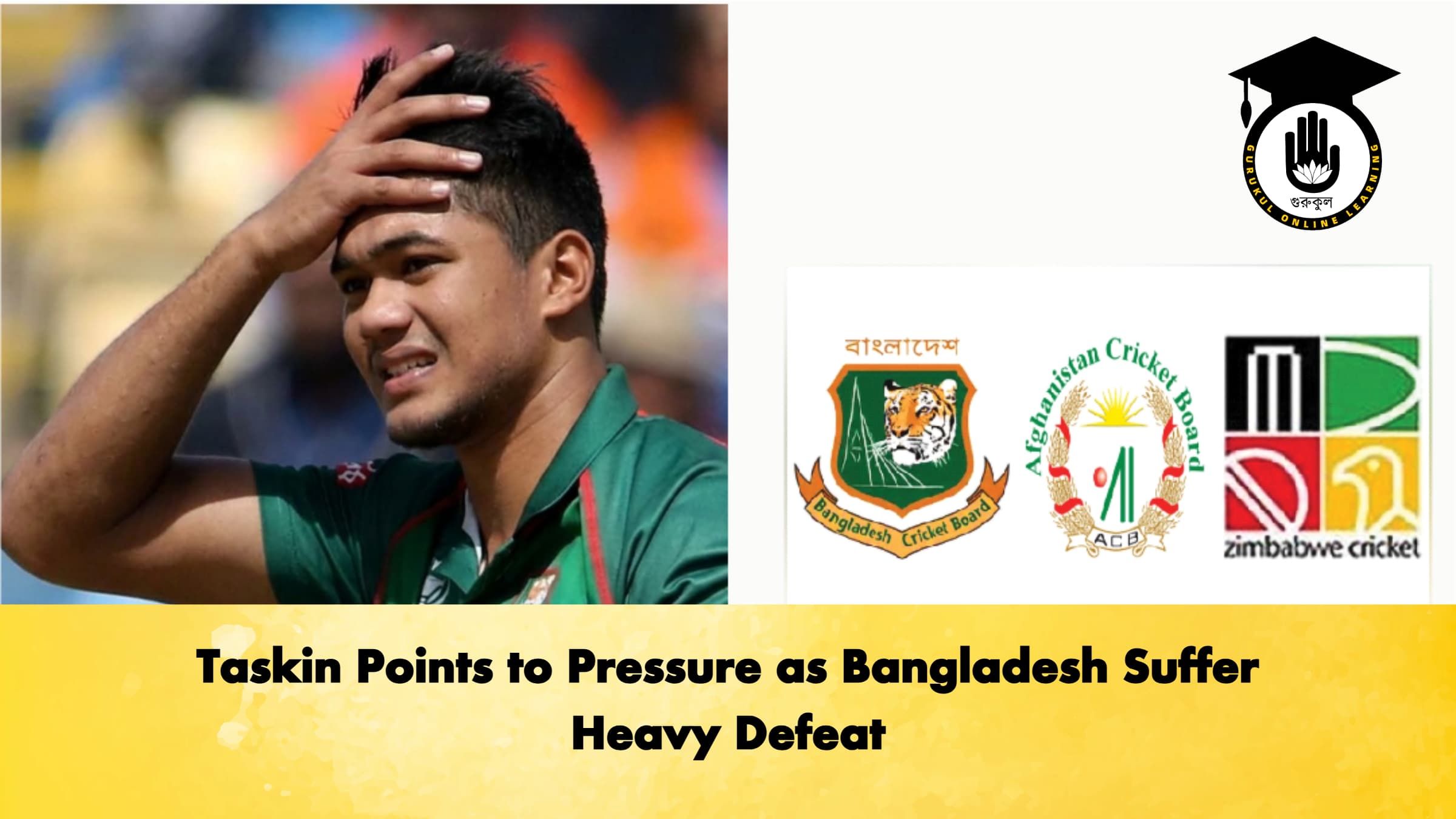
Bangladesh’s batting frailties were once again exposed as they began their tri-nation series in the United Arab Emirates with a 99-run defeat against Zimbabwe. Despite being in a position to mount a serious challenge, Bangladesh collapsed in the latter stages of their run chase, losing their final seven wickets in just 17.4 overs to be bowled out for 172. Fast bowler Taskin Ahmed believes the team’s inability to handle pressure and build meaningful partnerships was a major factor behind the disappointing result.
Bangladesh appeared to have a reasonable chance of chasing Zimbabwe’s target of 272 when they reached 94 for three after 16 overs. Saif Hassan and Towhid Hridoy were at the crease, and the required scoring rate remained manageable. At that stage, a substantial partnership could have kept the visitors firmly in contention.
Instead, the innings unravelled. Wickets fell at regular intervals, scoring momentum disappeared and Bangladesh failed to recover from the mounting pressure. Their eventual total of 172 left them well short of the target and handed Zimbabwe a convincing victory.
Speaking after the match, Taskin argued that the pitch was suitable for batting and offered enough opportunities for Bangladesh to complete the chase. In his view, the team’s shortcomings were not primarily caused by difficult playing conditions but by its inability to make the most of the opportunities available.
“It was possible to bat for a long time on this pitch. There were opportunities to score runs, and we could have built substantial partnerships. The opposition showed that it was possible,” Taskin said.
Zimbabwe showed how to recover under pressure
The contrast between the two teams’ batting performances was striking. Zimbabwe had also endured an uncomfortable start, losing three wickets for just 26 runs. However, Brendan Taylor and Craig Ervine steadied the innings with a 150-run partnership, taking control of the match and laying the foundation for a competitive total.
Their stand demonstrated the importance of patience, composure and sound decision-making after an early collapse. Rather than allowing the loss of wickets to dictate their approach, the pair rebuilt the innings and capitalised on scoring opportunities.
Bangladesh, by comparison, could not establish a partnership of similar significance. Their batters struggled to maintain a balance between scoring runs and protecting their wickets. As dismissals continued, the pressure intensified, leaving those who followed with an increasingly difficult task.
Taskin felt that Zimbabwe’s performance should have served as evidence that the target was achievable.
“Honestly, considering the pitch, 270 runs was certainly a chaseable target. We bowled on this surface ourselves and saw how the opposition took advantage of even small mistakes,” he said.
His assessment highlights a familiar weakness in Bangladesh’s one-day international performances: the difficulty of rebuilding an innings when early progress is interrupted by the loss of wickets. In a run chase, partnerships are crucial not only for accumulating runs but also for preventing the required rate from becoming a source of additional pressure.
UAE conditions offered Bangladesh a winning opportunity
Taskin acknowledged that playing in Zimbabwe can be challenging, particularly because home conditions often give the hosts a significant advantage. He also pointed to Zimbabwe’s ability to put Australia under considerable pressure on their own ground.
However, he believed the conditions in the UAE should have allowed Bangladesh to compete more effectively and secure victory. Rather than attributing the result to the opposition or the pitch, he accepted that his team had failed to perform to the required standard.
“Playing in Zimbabwe is difficult. They have put Australia under considerable pressure in their own conditions. But in these conditions, we should have won the run chase. We simply did not play well enough. The biggest problem was that we failed to build any effective partnerships in our batting. Even one good partnership could have made it possible to win the match,” he said.
The comments underline the need for Bangladesh to improve their approach when chasing targets. A team can begin an innings at a satisfactory pace and still lose control if wickets fall too frequently. Maintaining composure, rotating the strike and selecting the right opportunities to attack are all essential to keeping a run chase on course.
Bangladesh’s inability to establish a stable middle order also left little room for a late acceleration. Once the wickets began to tumble, the remaining batters had to contend with increasing pressure and a shrinking margin for error.
Repeated batting collapses raise further concerns
The defeat has added to concerns about Bangladesh’s consistency in the 50-over format. The team have failed to bat through their full 50 overs in each of their last four ODIs against Zimbabwe, a sequence that highlights their difficulties in sustaining an innings.
Batting through the allotted overs does not automatically guarantee victory, but it gives a side more time to build partnerships, assess conditions and plan an effective finish. Losing wickets in clusters can undermine even a promising start, as Bangladesh’s latest performance demonstrated.
Taskin also expressed frustration at the recurrence of similar mistakes. His remarks suggest that the problem extends beyond isolated errors by individual batters. The team must find ways to remain composed when the opposition gains momentum and avoid allowing one setback to trigger a wider collapse.
For Bangladesh, the priority will be to address these weaknesses in the remaining matches of the tri-nation series. Greater discipline at the crease, improved communication between batters and a clearer strategy for managing the middle overs could help them avoid a repeat of the defeat.
Zimbabwe’s recovery after losing three early wickets offered a practical example of how patience and partnership-building can change the course of a match. Bangladesh had an opportunity to do the same but failed to seize it.
Taskin’s assessment was clear: the target was achievable, the conditions were favourable enough, and the team had a realistic chance of winning. What proved decisive was their inability to withstand pressure and turn that opportunity into a sustained batting performance.