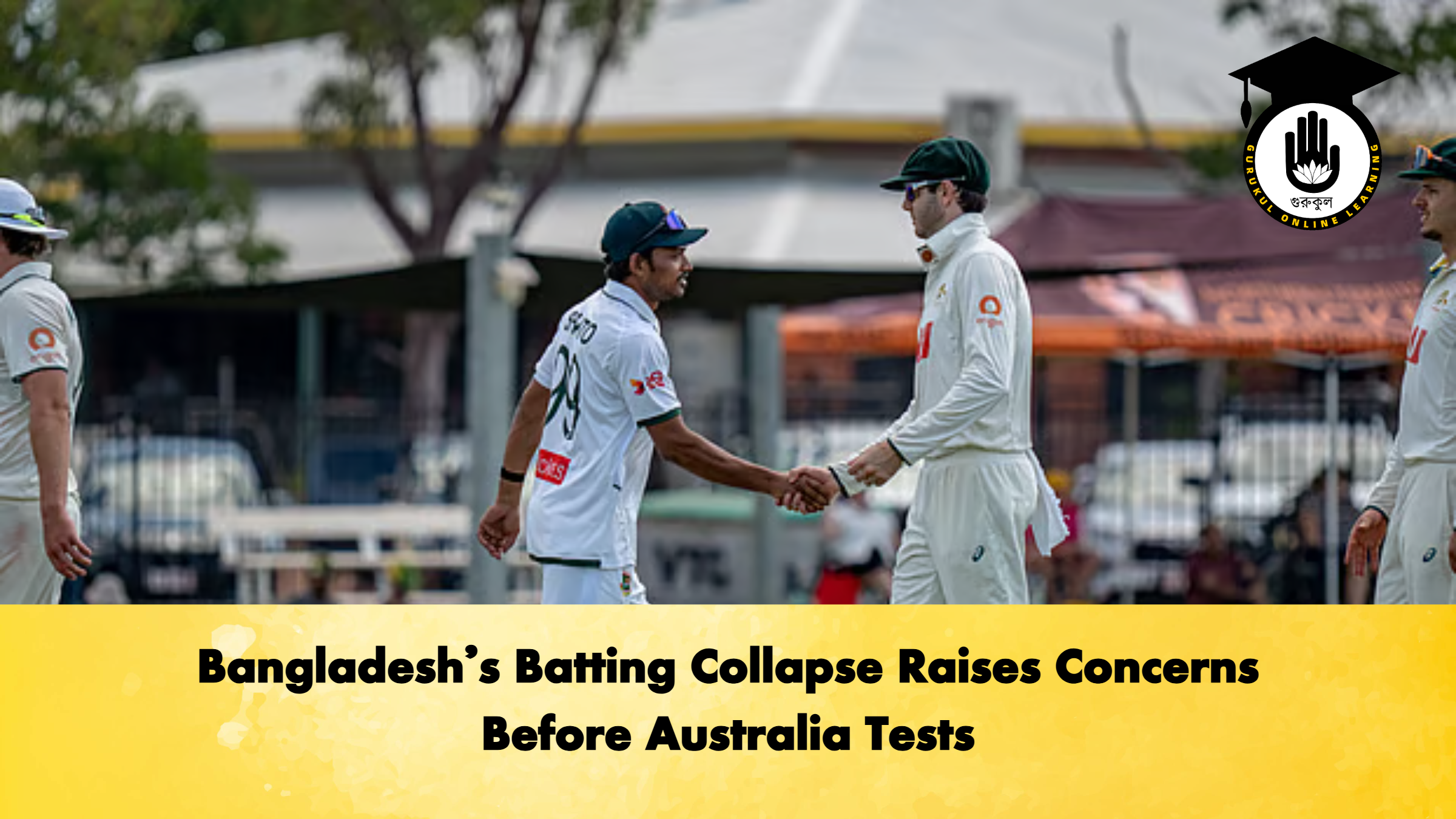
Bangladesh’s batting frailties were exposed in emphatic fashion just days before their Test series against Australia, as Najmul Hossain Shanto’s side suffered an innings-and-38-run defeat to a Cricket Australia XI in a three-day practice match at Marrara Oval in Darwin.
The visitors initially showed signs of competitiveness after making 263 in their first innings, with Mehidy Hasan Miraz producing an outstanding century. Yet the lack of substantial partnerships around him was a concern. No other Bangladesh batter managed to reach fifty, leaving Miraz to shoulder much of the responsibility for giving the innings a respectable total.
In reply, the Cricket Australia XI posted 355, securing a 92-run first-innings advantage. Although that deficit was recoverable in a practice match, Bangladesh needed a disciplined second-innings effort to gain valuable time in the middle and test themselves against Australian conditions.
Instead, the innings unravelled spectacularly.
Bangladesh finished the second day on 19 for two, with eight wickets still in hand. There was therefore a realistic opportunity to build a prolonged resistance on the final morning. That opportunity disappeared within just 17 overs, however, as the remaining eight wickets fell in rapid succession.
The innings eventually ended at only 54. Bangladesh therefore failed even to erase the 92-run deficit established by their opponents in the first innings.
Tanzid Hasan top-scored with 22 from 41 deliveries after resuming as an overnight unbeaten batter. No other Bangladesh player reached double figures. Miraz, the first-innings centurion, made only six from 19 balls in the second innings, while captain Najmul Hossain Shanto, Taskin Ahmed and Ebadot Hossain were dismissed without scoring.
Left-arm seamer Campbell Thompson was the chief architect of the collapse, claiming eight of Bangladesh’s ten wickets. Off-spinner Corey Rocchiccioli took the other two. Thompson’s performance was particularly striking given his limited experience.
At just 22, Thompson had yet to make his international debut. Before this match, he had played only two first-class games and taken three wickets. His List A record was similarly limited, with one wicket from two matches. For an established Test batting unit to struggle so severely against a relatively inexperienced bowler will inevitably attract attention.
The result, however, should be viewed in the context of a warm-up fixture rather than treated as a definitive forecast for the Test series. Practice matches allow touring teams to assess combinations, adapt to unfamiliar conditions and identify weaknesses before competitive cricket begins. In that respect, the Darwin defeat has provided Bangladesh with a clear warning.
Australian conditions traditionally place considerable demands on visiting batters. Pace, bounce and movement with the new ball can expose technical weaknesses, while the ability to concentrate for long periods is essential in Test cricket. Bangladesh will need to improve not only their shot selection but also their ability to absorb pressure and build partnerships.
Miraz’s century remains an encouraging feature of the match. His ability to construct a substantial innings demonstrates that runs can be scored in the conditions. But the second-innings collapse also underlined the danger of relying heavily on one or two individuals.
Bangladesh’s first Test against Australia is scheduled to begin in Darwin on 13 August, followed by the second Test in Mackay from 22 August. The prospect of facing Australia’s more experienced pace attack will make the lessons from Marrara Oval particularly relevant.
The top and middle order now have limited time to address the weaknesses exposed in Darwin. Judging deliveries outside off stump, coping with short-pitched bowling, surviving the early movement of the new ball and maintaining concentration over extended periods will all be crucial.
A defeat in a practice match does not determine the outcome of a Test series. But a second innings of 54 provides a statistic that Bangladesh cannot afford to dismiss. The warm-up fixture has identified a significant vulnerability; the challenge now is to correct it before the first Test begins.