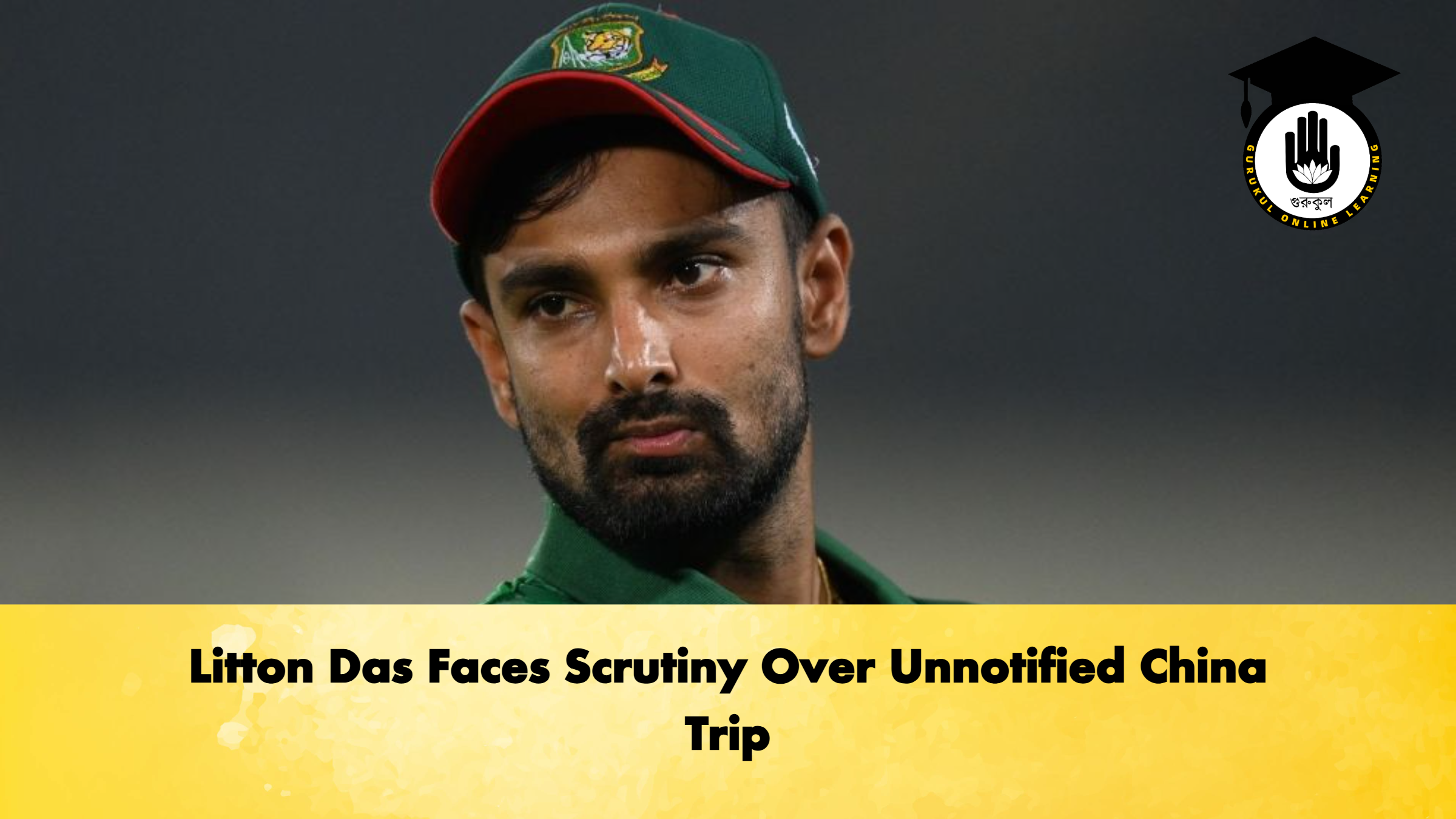
Bangladesh national T20I captain Litton Kumar Das has faced disciplinary scrutiny after travelling to China without reportedly securing the Bangladesh Cricket Board’s approval or properly informing the board. He was summoned before the disciplinary committee on Sunday over alleged breaches of the Bangladesh Cricket Board’s code of conduct and the terms of his central contract.
Litton appeared before the committee and was given an opportunity to explain his position. The board will now assess his statement alongside information about his physical condition, injury status and medical requirements before deciding what action, if any, should be taken.
The issue came to light after Litton returned to Bangladesh following the national team’s tour of Zimbabwe. According to sources familiar with the matter, he subsequently travelled to China without informing the board. As a centrally contracted cricketer and the captain of Bangladesh’s T20I side, his overseas travel raised questions within the board, particularly because he had been dealing with an injury at the time.
The circumstances surrounding the trip have therefore become the central issue before the disciplinary committee. The board is expected to establish whether Litton’s travel had any connection with his medical condition and whether the failure to communicate with officials amounted to a breach of contractual or disciplinary requirements.
BCB director Sirajuddin Mohammad Alamgir confirmed that Litton had appeared before the committee and presented his explanation. The next stage is expected to involve a review of his account alongside relevant medical information. The committee will consider the nature of his injury, the treatment he required and whether his decision to travel abroad was linked in any way to his health or rehabilitation.
The board’s medical committee could play a significant role in the process. Litton’s medical records and assessment of his physical condition may help establish whether there were legitimate health-related circumstances surrounding the trip. The disciplinary committee is expected to compare those details with the explanation provided by the player before reaching a decision.
At this stage, the board has not publicly characterised the matter as a deliberate act of indiscipline. Instead, the initial indications suggest that the main concern centres on a failure of communication. Even so, centrally contracted players are generally expected to keep the board informed about matters that may affect their availability, fitness and participation in national team activities. Overseas travel during an injury-related period can be particularly sensitive because the board needs accurate information to coordinate medical care, rehabilitation and selection planning.
Litton’s recent injury history has added another layer to the situation. He suffered a calf muscle injury during the home ODI series against Australia earlier this year. His recovery was not sufficiently advanced for him to take part in the subsequent T20I series against the same opponents. He was also unavailable for the Test series against Zimbabwe.
Litton later joined the ODI squad, but his injury problem resurfaced, forcing him to cut short his involvement in the tour and return home. His prolonged absence from competitive cricket has complicated his return to international action and raised concerns about his fitness management.
There had also been plans for Litton to play in the Lanka Premier League, which was one of the factors behind his decision to sit out Bangladesh’s T20I series against Zimbabwe. However, he ultimately could not take part in the Sri Lankan domestic T20 competition because of his injury. The repeated setbacks have kept him away from regular competitive cricket and have reportedly contributed to his frustration as he attempts to regain full fitness.
To obtain a clearer assessment of his current condition, Litton is expected to travel to Singapore on 20 July. The visit is intended to facilitate a further evaluation of his physical condition and provide medical advice where necessary. Given the involvement of the BCB medical committee in his treatment and rehabilitation, the findings from that process could also be relevant when the disciplinary authorities consider the circumstances surrounding his China trip.
Litton has generally maintained a relatively low-profile disciplinary record throughout his international career, with few major controversies of this nature. Alamgir has also highlighted that background. Based on the information available so far, there is no clear indication that Litton deliberately sought to disregard the board’s regulations. The immediate concern appears to be that he failed to maintain the required communication with the board at a time when his fitness and availability were already matters of interest.
That distinction could prove significant when the committee decides on the appropriate response. If the board concludes that the incident was primarily the result of a communication failure rather than deliberate defiance, the eventual action could be limited to a warning or administrative measure rather than a severe disciplinary penalty.
At the same time, Litton’s status as a senior international cricketer and national team captain means that the matter has attracted additional attention. Leadership responsibilities do not exempt a player from contractual obligations, and the board is likely to emphasise the importance of maintaining clear communication in matters involving travel, medical treatment and rehabilitation.
The episode also highlights the broader relationship between centrally contracted players and the board. Effective injury management requires regular communication between athletes, medical staff, team management and administrators. When that communication breaks down, uncertainty can arise over a player’s availability, treatment plans and participation in upcoming assignments.
For Litton, the immediate priority remains his fitness and a safe return to competitive cricket. The disciplinary issue, meanwhile, will depend on the committee’s assessment of his explanation and the medical evidence available to it. Once his statement, medical evaluation and injury-related information have been reviewed, the BCB will determine whether any further action is necessary.
For now, the indications are that the board is more likely to focus on reinforcing the need for proper communication and compliance with established procedures than pursuing a major punishment. The final decision, however, will rest with the disciplinary committee after it completes its review of the matter.