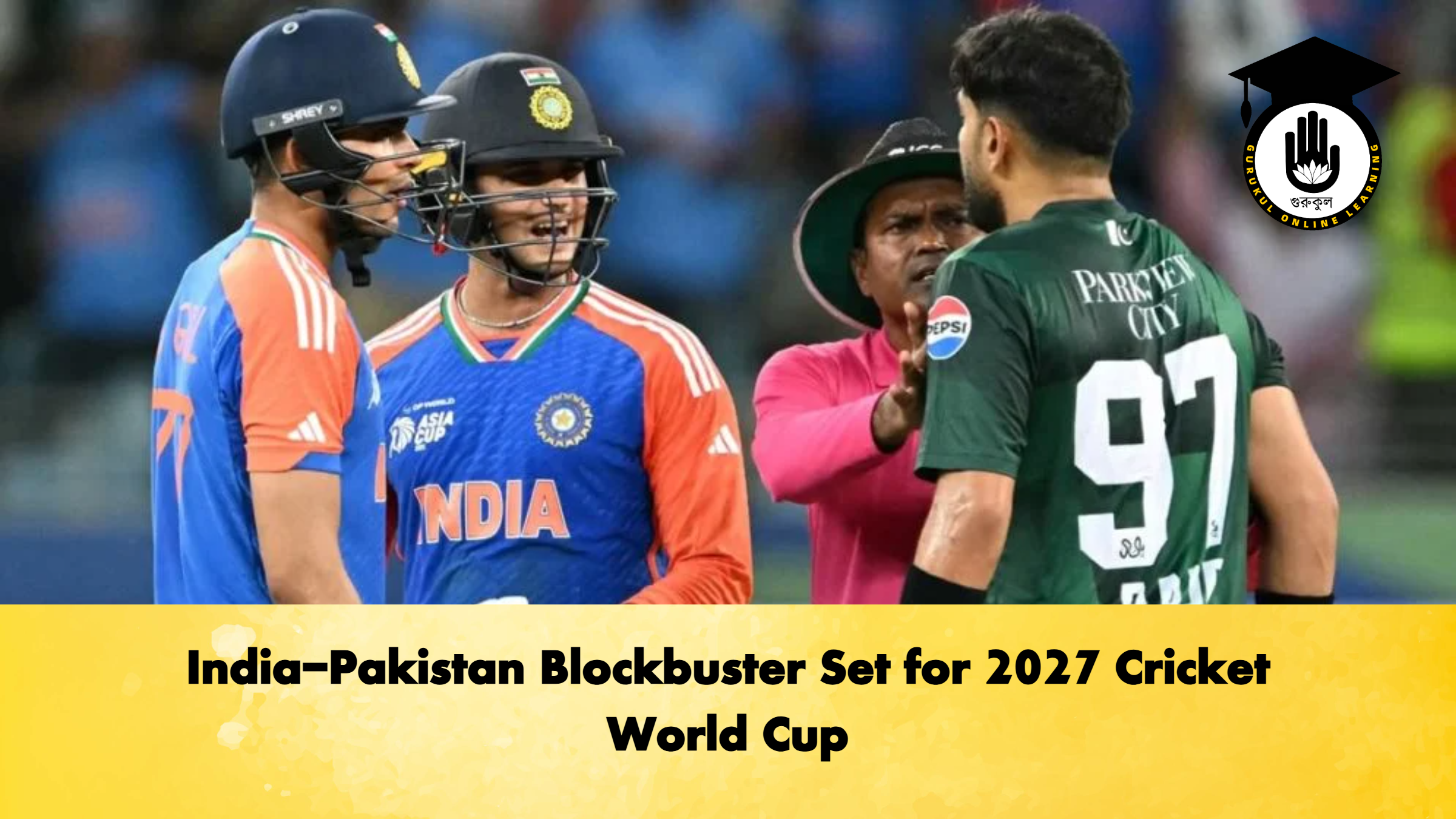
Fixtures between traditional arch-rivals India and Pakistan consistently capture the global sporting imagination, generating unmatched levels of tension and excitement across every single match. Due to complex geopolitical and border issues between the two nations, encounters on the cricket pitch rarely take place outside of major tournaments organised by the International Cricket Council (ICC) or the Asian Cricket Council (ACC). Consequently, cricket supporters around the world eagerly anticipate these rare showdowns.
The ICC has officially unveiled the tournament schedule during a special event held in Cape Town, South Africa, setting the stage roughly one year in advance of the tournament. Everything is currently on track for the men’s cricket world cup to commence in October and November of 2027. The marquee group-stage fixture between India and Pakistan has been locked in for 10 October. Meanwhile, the tournament will officially get underway on 7 October with an opening match featuring the finalists of the previous World Cup, India and Australia.
Group assignments were revealed during the Cape Town gathering. India has been placed in a group alongside Pakistan, Afghanistan, Australia, Zimbabwe, and a yet-to-be-determined qualifying side. Group B features Bangladesh, England, South Africa, Sri Lanka, New Zealand, and a second qualifying team. Preliminary qualification matches are slated for 2, 4, and 6 October to determine the final entrants into the main draw. The two semi-finals are scheduled for 17 and 18 November, culminating in the grand finale on 21 November.
The qualification pathway leading to the latter stages of the tournament involves multiple tiers of competition. Action begins with a “Super Series” featuring the three lowest-ranked nations out of fourteen aspiring teams, playing in a round-robin format where the top performers advance. The second round expands to include twelve teams spread across two groups of six, playing thirty matches in total. Every team plays each other within their group, with the top three from each group—alongside the single best fourth-placed side overall—advancing to the “Super Seven” stage, running from 7 to 24 October.
The third round begins on 25 October, hosting twenty-one round-robin matches where the seven qualifying sides face one another once. Points accumulated from prior rounds are wiped clean, meaning every participant starts this phase with a clean slate. The top four teams based on this round’s standings earn qualification for the semi-finals. Should India and Pakistan both advance through their initial groups, they will square off once more during this Super Seven phase.
To streamline organization, the ICC pre-assigned seeding slots for the Super Seven stage, designating India as A1, followed by Australia (A2), Pakistan (A3), England (A4), New Zealand (B1), South Africa (B2), and Sri Lanka (B3). If an alternative team displaces a pre-assigned nation during the group phase, the newcomer inherits that specific seeding number. For example, if Afghanistan displaces Australia, they assume the A2 designation, whereas if Bangladesh replaces Sri Lanka, they take over the B3 slot.
Benefiting from their high position in international rankings, the Indian team bypasses the earliest qualification rounds entirely. Led by players like Shubman Gill, India enters directly into the second round, where they are guaranteed at least five matches, followed by a minimum of six fixtures in the Super Seven stage. Factoring in the knockout rounds, a run to the final would require India to play a total of thirteen matches across the tournament.